About SoftWave
The Science Behind Your Healing
German-engineered. FDA-cleared. Backed by decades of research and trusted by MLB, NFL, NBA, and the world's top medical institutions. Here's everything you need to know.
What Makes SoftWave Different
SoftWave isn't just another shockwave device. Its patented electrohydraulic mechanism with parabolic reflector creates the widest, deepest, and most biologically effective treatment available.
Watch: What Is SoftWave?
SoftWave Featured in Cumberbatch Magazine
PDF Article — Open in new tab
SoftWave in PM Digital Magazine
PDF Article — Open in new tab
True Shockwave vs. Pressure Wave
Most clinics use radial pressure waves and call it “shockwave therapy.” It's not the same thing.
| Feature | Radial (Pressure Wave) | Focused Shockwave | SoftWave (Unfocused) |
|---|---|---|---|
| True shockwave? | ❌ Pressure wave only | ✅ Yes (narrow) | ✅ Yes (broad-focused) |
| Depth | 3-4 cm | Up to 12 cm (pinpoint) | Up to 12 cm (wide) |
| Width | Surface-level | ~2 mm focal point | 7 cm wide |
| Stem cell activation | ❌ Not proven | Limited evidence | ✅ Proven |
| Typical sessions | 12-20+ | 6-10 | 6-8 |
| Causes tissue trauma | Possible at high energy | Possible | ❌ No microtrauma |
| Patient comfort | Moderate-high discomfort | Moderate discomfort | Generally well tolerated |
| Real-time feedback | Limited | Limited | ✅ Interactive feedback |
True shockwave?
Radial
❌ Pressure wave only
Focused
✅ Yes (narrow)
SoftWave
✅ Yes (broad-focused)
Depth
Radial
3-4 cm
Focused
Up to 12 cm (pinpoint)
SoftWave
Up to 12 cm (wide)
Width
Radial
Surface-level
Focused
~2 mm focal point
SoftWave
7 cm wide
Stem cell activation
Radial
❌ Not proven
Focused
Limited evidence
SoftWave
✅ Proven
Typical sessions
Radial
12-20+
Focused
6-10
SoftWave
6-8
Causes tissue trauma
Radial
Possible at high energy
Focused
Possible
SoftWave
❌ No microtrauma
Patient comfort
Radial
Moderate-high discomfort
Focused
Moderate discomfort
SoftWave
Generally well tolerated
Real-time feedback
Radial
Limited
Focused
Limited
SoftWave
✅ Interactive feedback
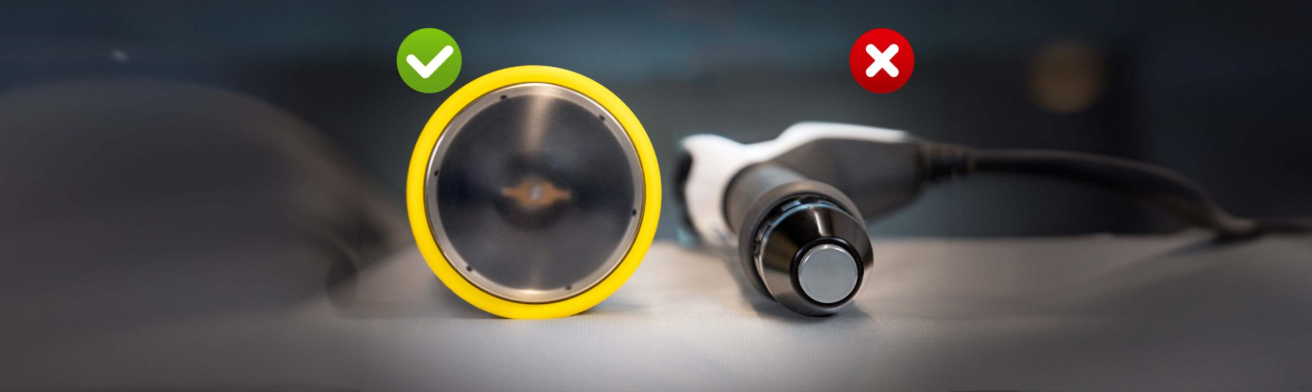
SoftWave's broad-focused applicator (left) vs. a radial pressure wave device (right)
What Is Shockwave Therapy?
Shockwave therapy is a non-invasive medical treatment that delivers acoustic energy into injured tissue to spark your body's natural healing response. It's been used in medicine since the 1950s — and the science has only gotten better.
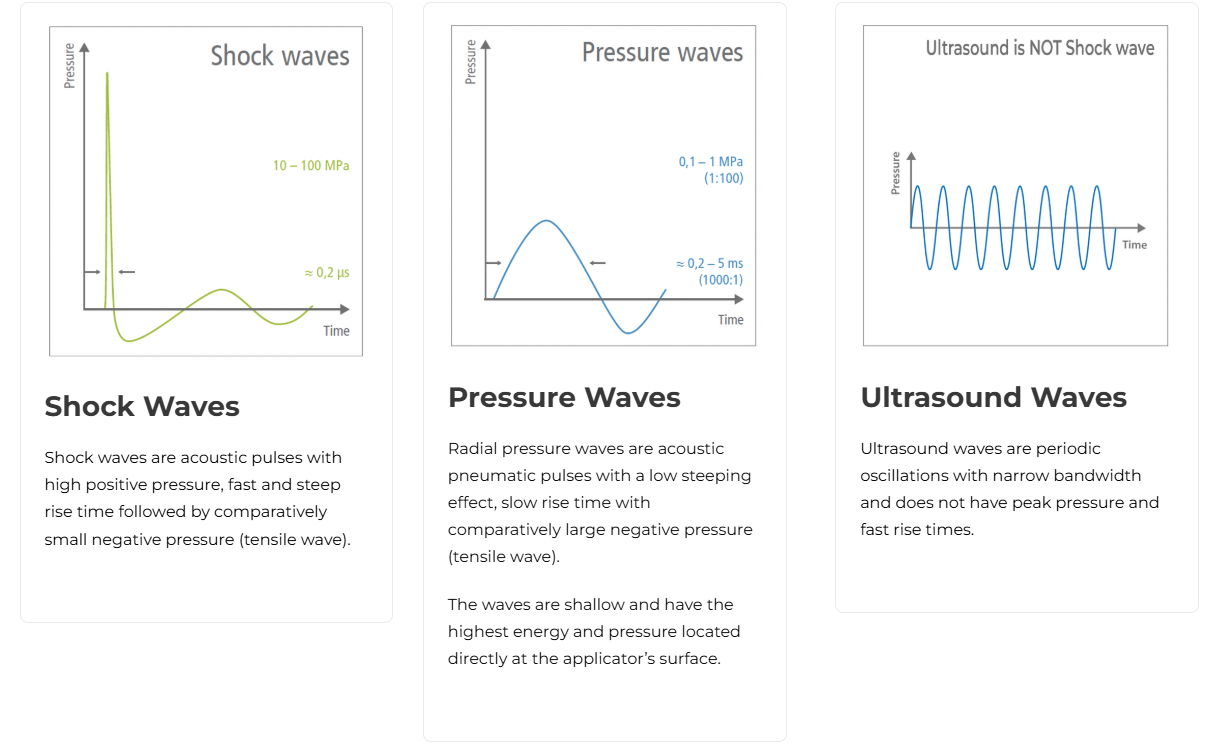
What Is a Shockwave?
A shockwave is created by a high-energy electrical discharge in water. The voltage arcs between two electrode tips, creating a hot plasma bubble that explodes in all directions. This compresses the surrounding water and generates a pressure exceeding 10 MPa within nanoseconds.
Despite traveling at over 3,355 mphin water (5x faster than in air), therapeutic shockwaves do not cause microtrauma to your tissue. They activate cellular receptors and initiate your body's own biological healing response.
From Disintegration to Regeneration
Shockwaves were originally developed for lithotripsy— breaking apart kidney stones without surgery. Scientists discovered that the same energy, at modified levels, could stimulate tissue regeneration instead of destroying it.
Over 70 years of research later, shockwave therapy is now one of the most well-studied non-invasive regenerative treatments in medicine. The technology has evolved from disintegrating kidney stones to regenerating damaged tendons, ligaments, bones, nerves, and blood vessels.
3 Types of Shockwave — And Why It Matters
Not everything called “shockwave therapy” is actually shockwave therapy. Here's the truth about what's on the market:
1. Electrohydraulic (SoftWave)
True shockwave generated by spark-gap discharge in water with a patented parabolic reflector. Produces broad-focused waves that reach 12 cm deep and 7 cm wide.
✅ True shockwave — broad focused2. Electromagnetic (Focused)
True shockwave, but energy is concentrated into a very narrow focal point (~2 mm). Requires many more pulses and sessions to cover the same area. Commonly used in urology and kidney stones.
✅ True shockwave — pinpoint focused3. Radial (Pressure Wave)
Not a true shockwave.Uses a pneumatic mechanism (like a tiny jackhammer) to create pressure waves that disperse near the surface. Only reaches 3-4 cm deep. Most common device in clinics because it's cheapest.
❌ Not a true shockwaveBottom line:When someone tells you they offer “shockwave therapy,” ask what type of device they use. A radial pressure wave and SoftWave are about as similar as a flashlight and a laser — both produce light, but they do very different things.
SoftWave vs Other Devices
Shockwave Therapy Overview
Confusion in the Marketplace
You'll see many names used interchangeably, but they are not all the same technology:
Only electrohydraulicdevices (like SoftWave) produce true broad-focused shockwaves with proven stem cell activation. Don't get fooled by the terminology.
The History of Shockwave Therapy
Shockwave therapy isn't new — it's been used in medicine for over 70 years.
First Medical Investigation
First systematic medical investigation of shockwaves and their biological effects.
German Research Begins
German researchers begin studying shock waves and their interaction with biological tissue.
First Kidney Stone Treatment
First successful kidney stone disintegration via lithotripsy — shockwaves enter clinical use.
Bone Healing Experiments
Initial experiments using shockwaves to stimulate bone healing and fracture repair.
Tendon Treatment Success
First published reports on treating calcific tendinitis with 70-80% success rates.
SoftWave Founded
SoftWave Tissue Regeneration Technologies established — bringing electrohydraulic shockwave technology to the US market.
Cardiac Breakthrough
SoftWave co-authored study published in the European Heart Journal demonstrating cardiac tissue regeneration following bypass surgery.
What Shockwave Therapy Treats
Musculoskeletal
- Knee Pain
- Frozen Shoulder
- Plantar Fasciitis
- Tennis Elbow
- Carpal Tunnel
- Sciatic Pain
- IT Band Syndrome
Neuropathy
- Diabetic Neuropathy
- Chemo-Induced Neuropathy
- Toxicity-Induced Neuropathy
- Peripheral Nerve Pain
Urology
- Erectile Dysfunction
- Peyronie’s Disease
- Chronic Pelvic Pain
- Stress Urinary Incontinence
Wound Care
- Diabetic Ulcers
- Arterial Ulcers
- Decubitus Ulcers
- Non-Healing Wounds
Aesthetics
- Cellulite Reduction
- Skin Tightening
- Scar Tissue Treatment
Post-Surgical
- Adhesion Breakdown
- Scar Tissue
- Stiffness Recovery
- Accelerated Healing
Experience SoftWave in Columbia, MO
We use the most advanced shockwave device on the planet at SoftWave By MoloTherapy. Book your evaluation and feel the difference for yourself.
How SoftWave Works at the Cellular Level
SoftWave sparks your body's natural healing through a 3-phase process called mechanotransduction.
Watch: How Does SoftWave Work?
1. Physical Phase
A high-energy electrical discharge in water creates a plasma bubble that explodes, generating a pressure wave exceeding 10 MPa in nanoseconds. The patented parabolic reflector distributes this energy 12 cm deep and 7 cm wide.
2. Chemical Phase
The mechanical stimulus activates cellular receptors, releasing biomolecules and triggering cell signaling cascades. Your body converts physical force into biochemical healing signals — mechanotransduction.
3. Biological Phase
The biochemical signals trigger angiogenesis, inflammation modulation, stem cell activation and migration, and tissue regeneration. This biological cascade continues for up to 12 weeks after each treatment.
The 4 Biological Effects
Pain Relief
Disrupts pain signaling pathways for both immediate and long-term relief without medications.
Inflammation Modulation
Helps your body resolve inflammation naturally rather than just masking it with pills.
Angiogenesis
Stimulates new blood vessel formation, bringing oxygen and nutrients to chronically under-supplied tissue.
Stem Cell Activation
Triggers migration of your body’s own stem cells to the treatment area for genuine tissue repair over 12 weeks.
What a Session Looks Like
- 1We apply ultrasound gel to the treatment area
- 2The SoftWave applicator is placed on the skin and moved methodically
- 3You feel a rapid tapping or pulsing — noticeable but very tolerable
- 4You give us real-time feedback — areas of damage feel more sensitive
- 5The whole treatment takes 5-10 minutes per region
- 6No downtime — drive home, go to work, hit the gym
Who Benefits Most
- Musculoskeletal injuries (knee, shoulder, back, elbow, foot)
- Sports-related injuries and overuse conditions
- Chronic pain lasting more than 3 months
- Post-surgical stiffness or scar tissue
- Peripheral neuropathy
- Urological conditions (ED, Peyronie’s, pelvic pain)
- Non-healing wounds and diabetic ulcers
- People who want to avoid surgery
Backed by Science
SoftWave therapy is supported by peer-reviewed research from leading medical institutions worldwide. Explore the studies below.
Extracorporeal Shockwave Therapy in the Management of Sports Medicine Injuries
Allison N. Schroeder, Adam S. Tenforde, Elena J. Jelsing
Read StudyPain & MusculoskeletalESWT for the Treatment of Chronic Pelvic Pain Syndrome
Darijus Skaudickas, Titas Telksnys, et al.
Read StudyPain & MusculoskeletalUse of Corticosteroids for Adult Chronic Pain Interventions — Guidelines from ASRA, AAPM, ASIPP, IPASP, and NASS
Honorio T. Benzon, Dalia Elmofty, et al.
Read StudySports MedicineUse of ESWT for Athletes and Physically Active Individuals: Systematic Review
Hye Chang Rhim, Jaehyung Shin, et al.
Read StudyPain & MusculoskeletalA Comprehensive Review of ESWT in the Management of Musculoskeletal Disorders
Afshan Perwe, Shivani Tiwari, et al.
Read StudyBack & SpineESWT for Treating Chronic Low Back Pain: Systematic Review and Meta-analysis
Lei Yue, Ming-shuai Sun, Hao Chen, et al.
Read StudyBack & SpineEffect of ESWT in Acute Traumatic Spinal Cord Injury: Study Protocol for Randomized Clinical Trial
Iris Leister, Rainer Mittermayr, et al.
Read StudyBack & SpineESWT Reduces Leg Cramps in Patients of Lumbar Degenerative Disorders: Retrospective Study
Bang-zhi Li, Heng-fei Li, et al.
Read StudyBack & SpineEffects of ESWT on Patients with Chronic Low Back Pain and Dynamic Balance Ability
Sangyong Lee, Daehee Lee, JungSeo Park
Read StudyPlantar Fasciitis & PodiatryEfficacy of Unfocused Medium-Intensity ESWT for Plantar Fasciitis
Ashraf Fansa, Alec J. Talsania, et al.
Read StudyPlantar Fasciitis & PodiatryACFAS Clinical Consensus Statement: Diagnosis and Treatment of Adult Acquired Infracalcaneal Heel Pain
Harry P. Schneider, John Baca, et al.
Read StudyPlantar Fasciitis & PodiatryCurrent Evidence of ESWT in Chronic Achilles Tendinopathy
Ludger Gerdesmeyer, Rainer Mittermayr, et al.
Read StudyUrologyLow-Intensity Shockwave Therapy for ED: Long-Term Outcomes of a Randomized Sham-Controlled Trial
Moritz Lange, David Charles, et al.
Read StudyUrologyVariations in Low Intensity Shockwave Treatment Protocols for ED: Review and Guide
Solomon Hayon, Evan J. Panken, Nelson E. Bennett
Read StudyUrologyRandomized Trial of Low Intensity Shockwave Therapy for ED Utilizing Grayscale Ultrasound Analysis
Sue W. Goldstein, Noel N. Kim, Irwin Goldstein
Read StudyUrologyMeta-analysis of RCTs Assessing Efficacy of Low Intensity Shockwave Therapy for ED
Jeffrey D. Campbell, Bruce J. Trock, et al.
Read StudyUrologyEffects of Low-Intensity ESWT on ED: Systematic Review and Meta-Analysis
Raul I. Clavijo, Taylor P. Kohn, et al.
Read StudyUrologyEffect of Low-Intensity Shock Wave Therapy on Moderate ED: Double-Blind, Randomized, Sham-Controlled Trial
Dimitrios Kalyvianakis, Ioannis Mykoniatis, et al.
Read StudyUrologyShock Wave Therapy for ED: Marketing and Practice Trends in Major US Metropolitan Areas
James M. Weinberger, Gary K. Shahinyan, et al.
Read StudyUrologyShock Wave Therapy for ED: Patterns of Care and Efficacy
Juan J. Andido, Jefferey C Morrison, et al.
Read StudyUrologyPotential Applications of Low-Intensity ESWT in Urological Diseases via Activation of Tissue Resident Stem Cells
Bohan Wang, Amanda B. Reed-Maldonado, et al.
Read StudyUrologyRetrospective Review of Improvement of Erectile Function After Low Intensity Shockwave Treatment with UroGold
Yih J., Goldstein S., et al.
Read StudyUrologyPenile Low Intensity Shock Wave Therapy for PDE5i Non-Responders with Vasculogenic ED
Curbelo, J. R. Sánchez, et al.
Read StudyUrologyEffectiveness of Shock Wave Therapy: Implementation of Soft Wide Focus Applicator in Patients with ED
Saffon, Jose
Read StudyUrologyEfficacy of ESWT for Males with Chronic Pelvic Pain Syndrome: Phase III, Randomized, Double Blind, Placebo-Controlled Study
S. Ramon Rona, R. A. Lorente Garin, et al.
Read StudyUrologyTreatment of Stress Urinary Incontinence with Low-Intensity ESWT in a Rat Model
Alex K. Wu, Xiaoyu Zhang, et al.
Read StudyUrologySuccessful Treatment of Hard Flaccid Syndrome with Multimodal Therapy: A Case Report
R. Omer Yazar, Muhammed A. M. Hammad, et al.
Read StudyWound Care & BurnsESWT for Treating Foot Ulcers in Adults with Type 1 and Type 2 Diabetes: Systematic Review and Meta-Analysis of RCTs
Qiangru Huang, Peijing Yan, et al.
Read StudyWound Care & BurnsESWT for the Treatment of Chronic, Non-Healing Wounds: A Case Series
Belinda Marcus
Read StudyWound Care & BurnsUse of ESWT to Treat Non-Healing Venous Leg Ulcers: A Case Series
Matthew Regulski
Read StudyWound Care & BurnsAccelerated Reepithelialization of Superficial Second-Degree Burn Wounds Using ESWT: Prospective Randomized Phase II Trial
Christian Ottomann, Alexander Stojadinovic, et al.
Read StudyWound Care & BurnsAccelerated Re-epithelization of Skin Graft Donor Sites Using ESWT: Prospective Randomized Trial
Christian Ottomann, Bernd Hartmann, et al.
Read StudyRegenerative ScienceCellular Signaling Pathways Modulated by Low-Intensity Extracorporeal Shock Wave Therapy
Tianshu Liu, Alan W. Shindel, et al.
Read StudyRegenerative ScienceESWT in the Treatment of Nonunion in Long Bones: Systematic Review and Meta-Analysis
Valerio Sansone, Domenico Ravier, et al.
Read StudyRegenerative ScienceTLR3 Signalling Mediates Angiogenic Response Upon Shock Wave Treatment of Ischaemic Muscle
Johannes Holfeld, Can Tepekoylu, et al.
Read StudyRegenerative ScienceCardiac Shockwave Therapy in Addition to Coronary Bypass Surgery: The CAST-HF Trial
Johannes Holfeld, Felix Nägele, et al.
Read StudyClinical ReviewsShock Wave Therapy in Basic Research and Clinical Applications — From Bench to Bedside
Piotr Rola, Adrian Włodarczak, et al.
Read StudyClinical ReviewsMTS Clinical & Preclinical Studies: Compendium of Published Study Abstracts
MTS (Medical Technology Solutions)
Read StudyTrusted by the Best in the World
Used at leading medical centers and by professional sport organizations worldwide.
Professional Sports
Medical Institutions
FDA 510(k) Cleared
SoftWave is a Class II FDA-cleared medical device. Over $20 million invested in R&D. German-engineered with an extensive patent portfolio. VA SSF Contract/Schedule holder.
These studies represent a selection of the published research supporting shockwave therapy. Full compendium available upon request.
Frequently Asked Questions
Everything Columbia, MO residents ask us about SoftWave.
Extracorporeal Shockwave Therapy is a non-invasive treatment that delivers acoustic shockwaves into soft tissue and bone. These waves stimulate biological responses including angiogenesis (new blood vessel formation), inflammation modulation, and activation of dormant stem cells.
SoftWave uses a patented electrohydraulic mechanism with a parabolic reflector to generate broad-focused true shockwaves. Unlike devices that concentrate energy at a single painful point, SoftWave distributes energy across deep and superficial tissues — reaching up to 12 cm deep and 7 cm wide — without causing microtrauma. This activates mechanotransduction, converting physical force into biochemical healing signals.
Radial devices produce pressure waves, not true shockwaves. They have lower energy, slower rise time, and only penetrate 3-4 cm from the surface. SoftWave delivers true shockwaves that reach 12 cm deep with a 7 cm wide treatment zone. Radial devices typically require 12-20+ sessions; SoftWave achieves results in 6-8 sessions.
SoftWave is FDA 510(k) cleared for: relief of minor muscle aches and pains, temporary increase in local blood circulation, activation of connective tissue, treatment of chronic diabetic foot ulcers, and treatment of superficial partial-thickness second-degree burns. Providers also use it for a wide range of musculoskeletal, urological, and neuropathic conditions.
Generally very well tolerated. The broad-focused energy field feels much gentler than other shockwave devices. Treatments are interactive — you provide feedback and we adjust energy level, placement, and treatment area accordingly. Sessions typically last just 5-10 minutes.
Many clients report improvement after the first session. Standard protocols involve weekly treatments for 6-8 weeks, with progressive pain relief and improved function. Because SoftWave triggers long-term biological changes like new blood vessel growth and stem cell activation, results continue improving for months after your last session.
Because SoftWave stimulates genuine biological changes — new blood vessels, stem cell migration, tissue remodeling — results are designed to be lasting, not temporary. Many clients maintain benefits for months to years, especially when combined with the strength training in our MOLO Method.
The most common side effects are mild and temporary: slight redness, swelling, or soreness in the treated area, similar to after a deep tissue massage. These usually resolve within a few hours. SoftWave does not cause microtrauma, requires no anesthesia, and has no downtime.
SoftWave is FDA 510(k) cleared for specific indications. "Cleared" means the device is authorized for its labeled uses after FDA review. It is a Class II medical device — the same regulatory pathway used for most medical devices in the U.S.
Currently, SoftWave is generally a cash-pay procedure for musculoskeletal conditions. However, the total cost of a SoftWave treatment plan is typically significantly less than surgical alternatives, ongoing medications, or repeated cortisone injections.
Honestly, it depends. Some people need 3 sessions, some need 6, some need 8 or 12 — it all comes down to your specific condition, how long you've had it, and how your body responds. We use SoftWave to move you through the stages of healing and decrease your pain, not to keep you coming back forever. This is not something you'll need to do for the rest of your life. The goal is to get you better and get you out the door.
Completely different companies and technologies. SoftWave (our device) is medical therapy for pain relief, wound healing, and tissue regeneration using acoustic shockwaves. Sofwave is a cosmetic device for skin tightening. They are unrelated.
Still have questions? We're happy to help.
Ready to Give SoftWave a Shock?
If you're tired of pain, and you don't want any more pills, punctures, or procedures — give SoftWave a shock by Molotherapy.